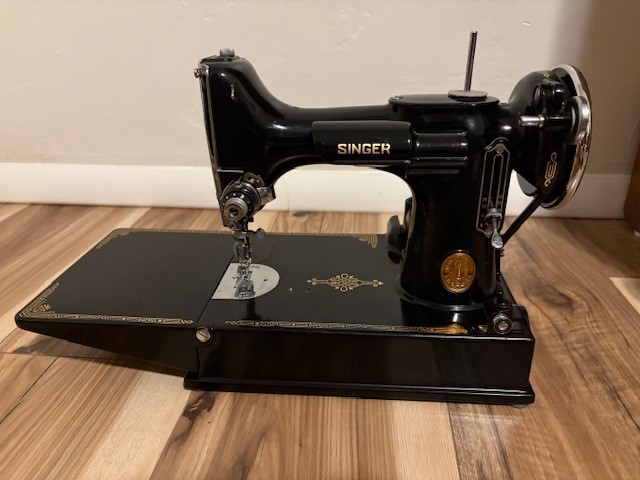
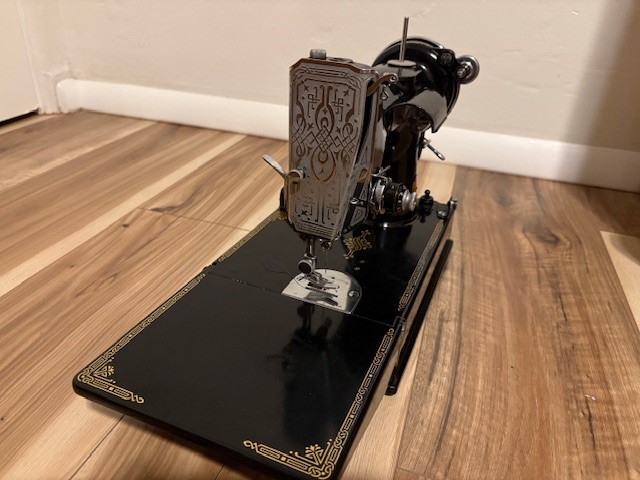
In her book, Featherweight 221 The Perfect Portable And Its Stitches Across History, Nancy Johnson-Srebro* writes regarding this popular Singer sewing machine…
“It had no cams nor computer circuitry. It wasn’t offered in designer colors. It’s didn’t do fancy stitching, not even a zigzag. It wasn’t made as a fancy, prestige model. It was lightweight when heavyweights dominated the field. It wasn’t cheap, nor was it outrageously expensive. But…it would become the standard by which all portable were judged, the benchmark. They called it the Perfect Portable, possibly the finest lightweight sewing machine on the market. They predicted you could use it for a life time, give it to your daughter and then to her daughter.”
Nancy Johnson-Srebro, Featherweight 221 The Perfect Portable and Its Stitches Across History
The first 10.000 Singer Featherweights were commissioned on October 3, 1933. The machine that I own was commissioned on August 15, 1940 and purchased by a church friend (now deceased) and her sister for $100.
When taking up quilting in 2001, the term “Featherweight” was foreign to me. Quickly I learned that owning a Featherweight seemed a natural expectation for a quilter. It was not a question of do you have a Featherweight but, how many Featherweights do you own?
A point of interest is how many Featherweight machines are used at the RWYS annual quilt retreat. Production of this Singer machine ceased in the late 1960’s. The newer sewing machines of today offer a variety of benefits. However, the basic, reliable Featherweight is still a treasure to have and to use.

So, how many Featherweight machines do you own?
*Featherweight 221 The Perfect Portable and Its Stitches Across History by Nancy Johnson-Srebro is available on Amazon.